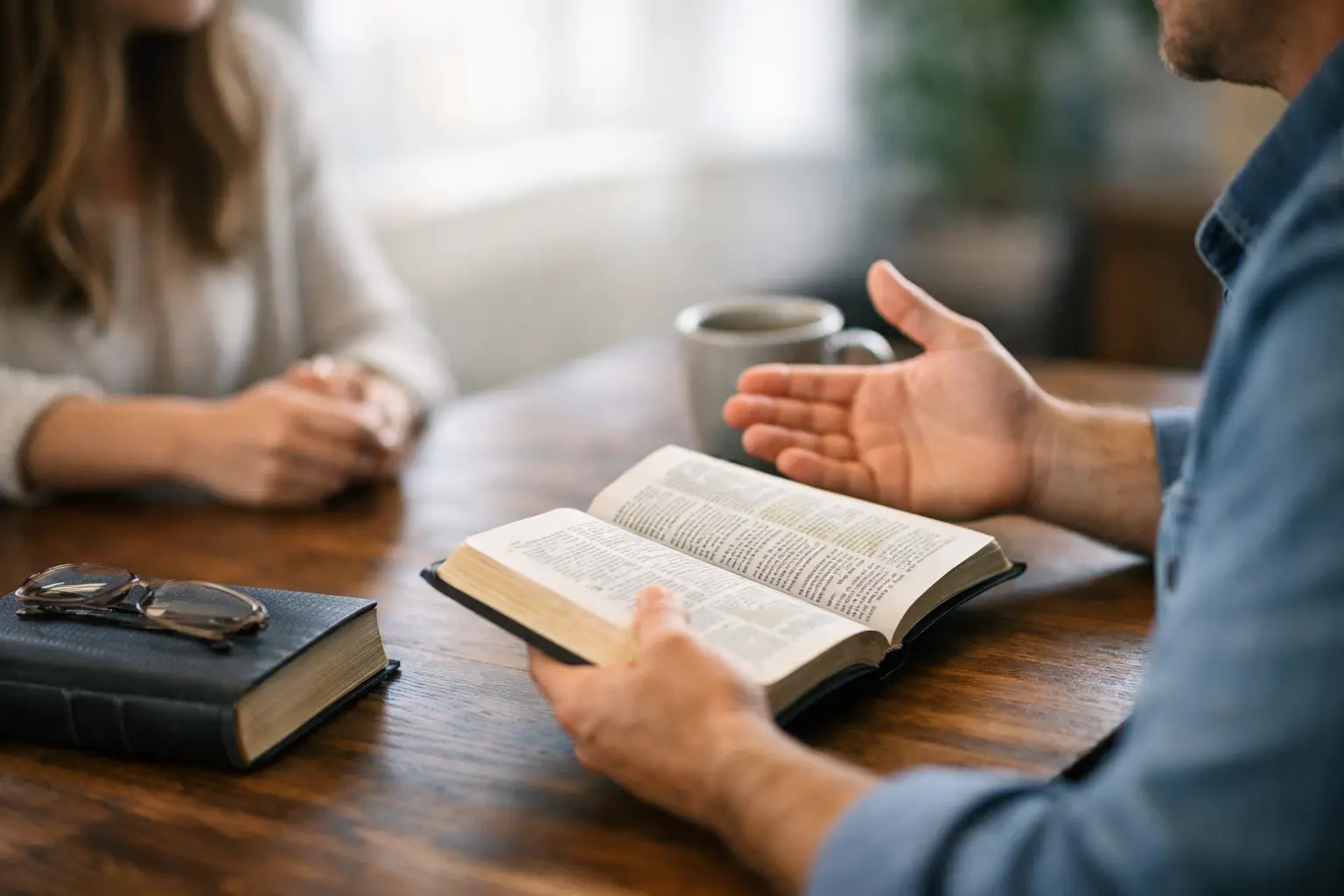
A meaningful Bible conversation rarely begins with someone having the perfect answer. More often, it begins when one person makes room for another to be honest. If you want to start meaningful scripture conversations, begin there: with a welcome that says, “You do not need to know everything to be here.”
For some people, opening the Bible with others feels natural. For others, it can feel exposing. They may worry they will be asked to explain a passage, say the right thing, or reveal more than they are ready to share. A relaxed, thoughtful conversation can lower that pressure. It helps Scripture become something people can encounter together, not a test they have to pass.
Why meaningful Scripture conversations matter
Scripture conversations are not only about gathering information. They can help us notice what we are carrying, hear another perspective, and remember that faith is lived in real relationships. A short passage discussed with care can lead to a deeper exchange than a long lesson delivered at people.
This matters especially when life feels disconnected. You might be new to an area, between churches, travelling, returning to faith, or simply tired of surface-level catch-ups. A small group can offer steady space to talk about hope, doubt, purpose, forgiveness, relationships, and the practical decisions in front of you.
The goal is not to force agreement on every point. Christian faith has convictions, and Scripture deserves to be treated seriously. Yet a healthy discussion also has room for people to ask questions, take time, and say, “I’m not sure what I think about that yet.” Curiosity is more than enough to begin.
Start with welcome, not expertise
The quickest way to close down a conversation is to make people feel they need a certain level of Bible knowledge before they can contribute. Instead, set a simple tone at the beginning: everyone is welcome to listen, share, or pass. No one needs to perform faith or have a polished answer.
This does not mean the conversation has no direction. It means the direction is relational as well as spiritual. Read the passage, give people a quiet moment to take it in, then ask a question that invites reflection rather than a lecture.
You could say, “What stands out to you?” or “What do you notice about the people in this story?” These are accessible questions for someone reading the Bible for the first time, but they can still lead to fresh insight for a long-time Christian.
It also helps to name the kind of space you want to create. A simple opening such as, “Let’s listen well, avoid fixing one another, and keep personal stories within this group,” gives people a clearer sense of safety. Confidentiality is especially important when conversations touch grief, family strain, anxiety, or past hurt.
Choose a setting that feels human
Meaningful conversations do not require a church hall, a workbook, or a highly organised programme. A lounge room, a quiet café, a park bench, or an online call can work well. What matters is that people can hear one another and settle in without feeling rushed.
Keep the first gathering simple. Offer tea, allow a few minutes for ordinary conversation, and do not make anyone introduce their entire life story. People tend to open up over time when the group is consistent and the atmosphere remains kind.
A group of five to eight people is often a helpful size. It is large enough for different perspectives but small enough that nobody disappears into the background. If only two or three people can come one week, meet anyway when possible. Consistency builds trust more reliably than a perfect turnout.
Use a passage that invites real conversation
When you are learning how to start meaningful scripture conversations, choose passages that are clear enough to enter without a lot of background explanation. Stories from the Gospels are often a gentle place to begin because they show Jesus meeting people in ordinary, complicated situations.
Consider a passage about Jesus calming the storm, speaking with the Samaritan woman, welcoming children, feeding the crowd, or meeting the disciples after the resurrection. Psalms can also be helpful, particularly when a group needs language for gratitude, fear, waiting, or lament.
Read the passage aloud once, then invite a second person to read it again. Hearing the words twice slows the pace and helps everyone notice more. You do not need to fill every silence. A few quiet seconds can give people permission to reflect instead of offering the first thing that comes to mind.
Context is useful, but keep it proportionate. If a passage needs a brief explanation of its setting, offer that in a sentence or two. Too much background too early can make the gathering feel like a class. The aim is to help people meet the text, not impress them with what you know.
Ask questions that open rather than corner
The best discussion questions are simple, specific, and spacious. They give people something real to respond to without pushing them towards a predetermined answer. Try moving from observation to reflection, then gently towards everyday life.
For example, you might ask:
- What do you notice in this passage?
- What does this show us about God, Jesus, or people?
- Which part feels encouraging, challenging, or difficult to understand?
- Where might this connect with real life this week?
You do not need to ask every question each time. Two good questions, followed by attentive listening, are usually better than a long string of prompts. If someone raises a difficult issue, resist the urge to settle it immediately. Thank them for naming it, acknowledge that faithful people can wrestle with hard passages, and suggest returning to it if the group needs more time.
Listen for the person, not just the answer
A conversation becomes meaningful when people feel heard. If someone shares an experience, do not rush to turn it into a teaching point. You can respond with, “Thank you for sharing that,” or “That sounds really hard.” Often, this is more helpful than trying to solve a problem in the moment.
Listening also means making room for different communication styles. One person may speak quickly and think out loud. Another may need time before sharing. A gentle facilitator can notice this and ask, “Would anyone who has not spoken yet like to add anything?” Then leave enough silence for the invitation to be real.
At the same time, kindness includes boundaries. If one person repeatedly dominates, redirects every discussion to themselves, or speaks harshly about others, it is appropriate to guide the group back towards mutual respect. Warmth is not the same as having no structure. Clear, light structure protects the welcome you are trying to offer.
Let the conversation lead to a small next step
Not every gathering needs a dramatic ending. Sometimes the most faithful response is a small one: carrying a verse into the week, checking in on someone, offering forgiveness, taking a walk to pray, or returning next time with another honest question.
You might close by asking, “Is there one thought from this passage you want to hold onto this week?” People can share briefly or keep their response private. If the group is comfortable, invite anyone who wishes to pray a short prayer. Keep the language natural and leave room for those who would rather listen.
Bible Study Connect Group exists because spiritual community should not be difficult to find or maintain. A little structure can remove the awkwardness of getting started, while genuine conversation gives people a reason to keep showing up.
You do not need to create a flawless gathering before you invite someone in. Choose a passage, make a little time, ask one open question, and listen with care. The next meaningful conversation may begin with a simple invitation: “Would you like to read this together?”