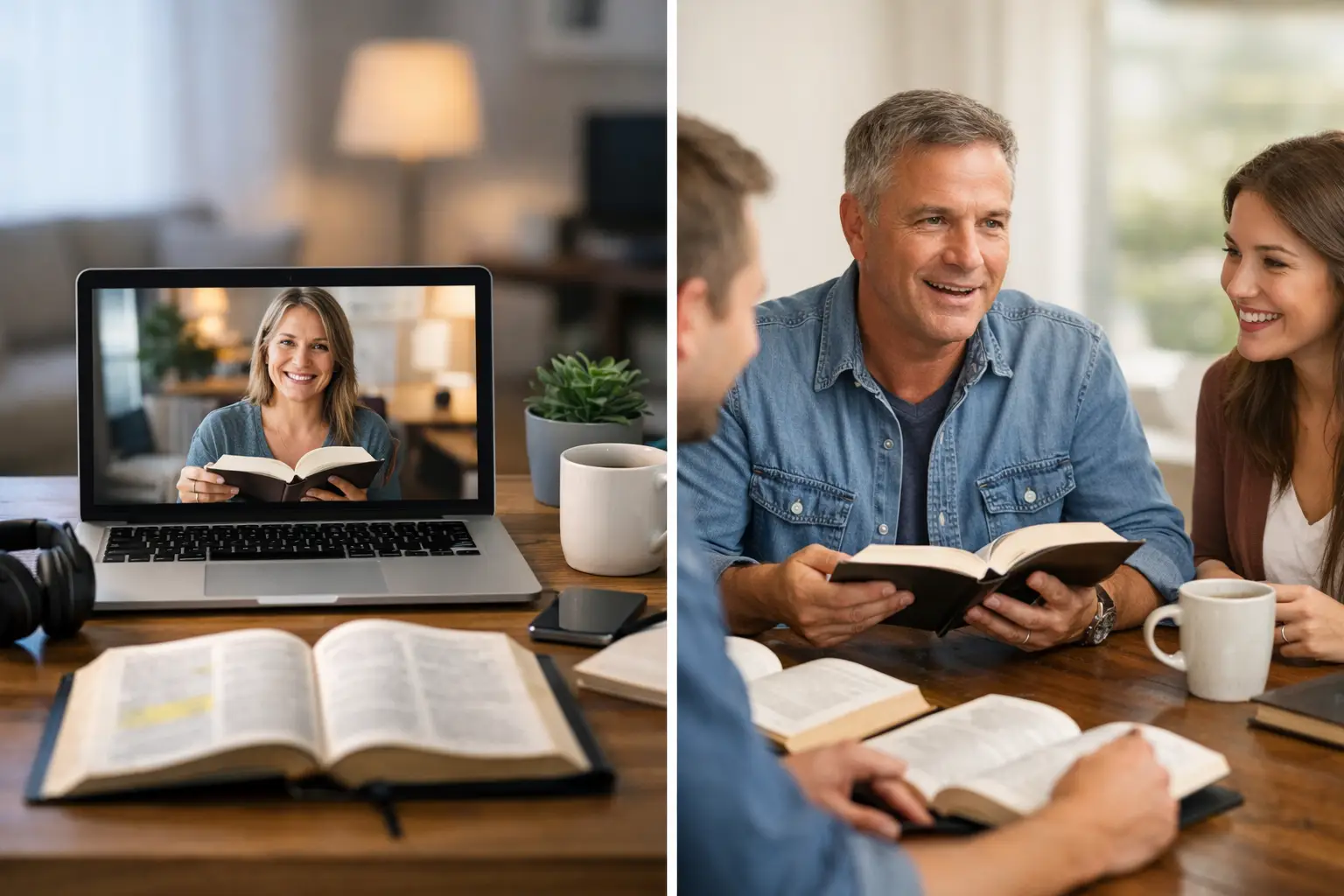
Some people open their laptop for Bible study after the kids are asleep. Others pull up a chair in someone’s lounge room, coffee in hand, ready for a real conversation. When it comes to online versus in person Bible study, the better option is not always the one that sounds more spiritual. Often, it is the one you will actually show up for, week after week, with honesty and openness.
That matters more than many people realise. Bible study is not only about information. It is also about being known, asking real questions, and building the kind of steady community that helps faith grow in ordinary life. If you have been trying to work out which format fits you best, it helps to be honest about what each one gives you and where each one falls short.
Online versus in person Bible study: what really changes?
The biggest difference is not the screen or the location. It is the shape of the experience.
Online groups usually make access easier. You can join from home, fit it around work or family life, and avoid the pressure of walking into a room full of strangers. For people who are new to faith, new to an area, travelling often, or simply feeling socially flat, that lower barrier can be a gift. Curiosity is more than enough to begin when the first step feels manageable.
In-person groups offer something different. They create a fuller sense of presence. You notice body language, pauses, warmth, laughter, and the small moments before and after the study that often turn into real friendship. A conversation can continue while putting mugs in the sink or walking back to the car. Those unplanned moments are hard to recreate online.
Neither format is automatically better for spiritual growth. What often matters more is consistency, safety, and whether people feel free to speak honestly.
Why online Bible study works for many people
For plenty of adults, online Bible study is the reason Bible study becomes possible at all. Life can be crowded. Shift work, caring responsibilities, long commutes, health limitations, and social anxiety all make it harder to commit to a physical gathering. Online groups remove some of that friction.
There is also a level of emotional safety that can help people start. If you are spiritually curious, rusty with Scripture, or unsure whether you belong in a Christian setting, joining by video can feel less exposing. You can listen first. You can get a feel for the group. You do not have to wonder where to sit, what to wear, or whether everyone already knows each other.
Online groups can also be surprisingly sincere. When a group is well matched and the conversation is thoughtful, people often share deeply. The screen does not prevent honesty. In some cases, it even helps. A person who finds face-to-face settings overwhelming may speak more openly from their own home.
Still, online study has limits. Conversation can become more structured because people cannot read the room as easily. It is harder to jump in naturally without talking over each other. Side conversations do not happen in the same way. If someone is drifting, tired, or distracted by what is happening around them, the group feels it.
Then there is the simple reality of screen fatigue. After a full day online, even a meaningful Bible study can feel like one more thing on the calendar.
Why in-person Bible study feels different
In-person Bible study often creates connection more quickly, especially for people who long for local community rather than just content. Sharing physical space changes the pace. People settle in. There is room for silence without it feeling awkward. A gentle conversation can unfold more naturally.
For Christians who feel isolated, or for those trying to build a sense of belonging in a new suburb or city, this can be deeply encouraging. Faith is lived in everyday places, not only in church buildings. A small group in a home, café, or park can become a regular place of welcome where people are known by name.
There is also a practical strength to meeting in person. Relationships often move beyond the study itself. Someone offers a lift. Someone checks in midweek. Someone remembers your hard week at work or asks how your family is doing. That sort of care is not guaranteed, but it tends to grow more easily when people share life in the same local area.
Of course, in-person groups are not effortless. Travel time matters. Parking matters. Childcare matters. So does the social energy required to turn up when you are tired or feeling uncertain. For some people, those barriers are not small. They are the very reason community has felt out of reach.
And while in-person settings can feel warmer, they can also feel more intense. If a group is not welcoming, the discomfort is immediate. That is why group culture matters just as much as format.
Choosing between online versus in person Bible study
The best choice often depends on your season, not your ideals.
If you are overwhelmed, stretched thin, or hesitant to join a group at all, online may be the wiser starting point. A simple and sustainable step is often better than a hopeful plan you cannot maintain. The same is true if you are travelling, living remotely, managing illness, or caring for others.
If you are specifically craving friendship, local belonging, and conversation that continues beyond the meeting itself, in-person may serve you better. That is especially true if your main struggle is not lack of Bible knowledge but lack of real community.
It is also worth asking yourself a more practical question: where do you tend to show up most faithfully? Some people love the idea of in-person groups but cancel often because life gets in the way. Others assume online will be easier, then disengage because the screen keeps them half-present. The goal is not to pick the format that sounds best. It is to choose the one that helps you participate honestly and consistently.
The quality of the group matters more than the format
A healthy group online will usually help you more than an unhealthy group in person. The reverse is true as well.
What makes a Bible study meaningful is not just where it meets. It is whether people are respectful, whether questions are welcome, whether the conversation stays grounded in Scripture, and whether the group feels safe enough for real life to be shared. You are welcome here should feel true in the room, not just written in an invitation.
This is especially important for mixed groups that include mature Christians, newcomers, and people still working out what they believe. A good group does not shame basic questions or reward polished answers. It makes space for honesty, reflection, and growth.
That is one reason thoughtful matching matters. A group of five to eight people with similar availability and a shared expectation of respectful conversation is often far more sustainable than a larger, loosely held gathering. Bible Study Connect Group is built around that kind of simple structure because consistency usually grows where social friction is lower and belonging feels real.
You may not need one format forever
Sometimes the right answer is both, just not at the same time.
An online group can be a gentle entry point when you are rebuilding confidence or testing whether group study fits your life. Later, an in-person group may become the next faithful step. In other seasons, you may begin with a local group and switch online when work, parenting, or health makes leaving home difficult.
That flexibility is not second best. It is often wise. Faith is lived through changing circumstances, and community has to be sustainable if it is going to last.
There is also no rule that says meaningful Bible study must look highly polished. Some of the most helpful groups are simple by design. A few people, an open Bible, honest discussion, and enough structure to keep meeting next week. Whether that happens around a table or on a screen, the value is in showing up with sincerity.
If you are weighing online versus in person Bible study, try not to ask which option is perfect. Ask which one helps you take the next real step towards Scripture, conversation, and community. The right place to begin is usually the place where you can arrive as you are, stay consistent, and let connection grow over time.