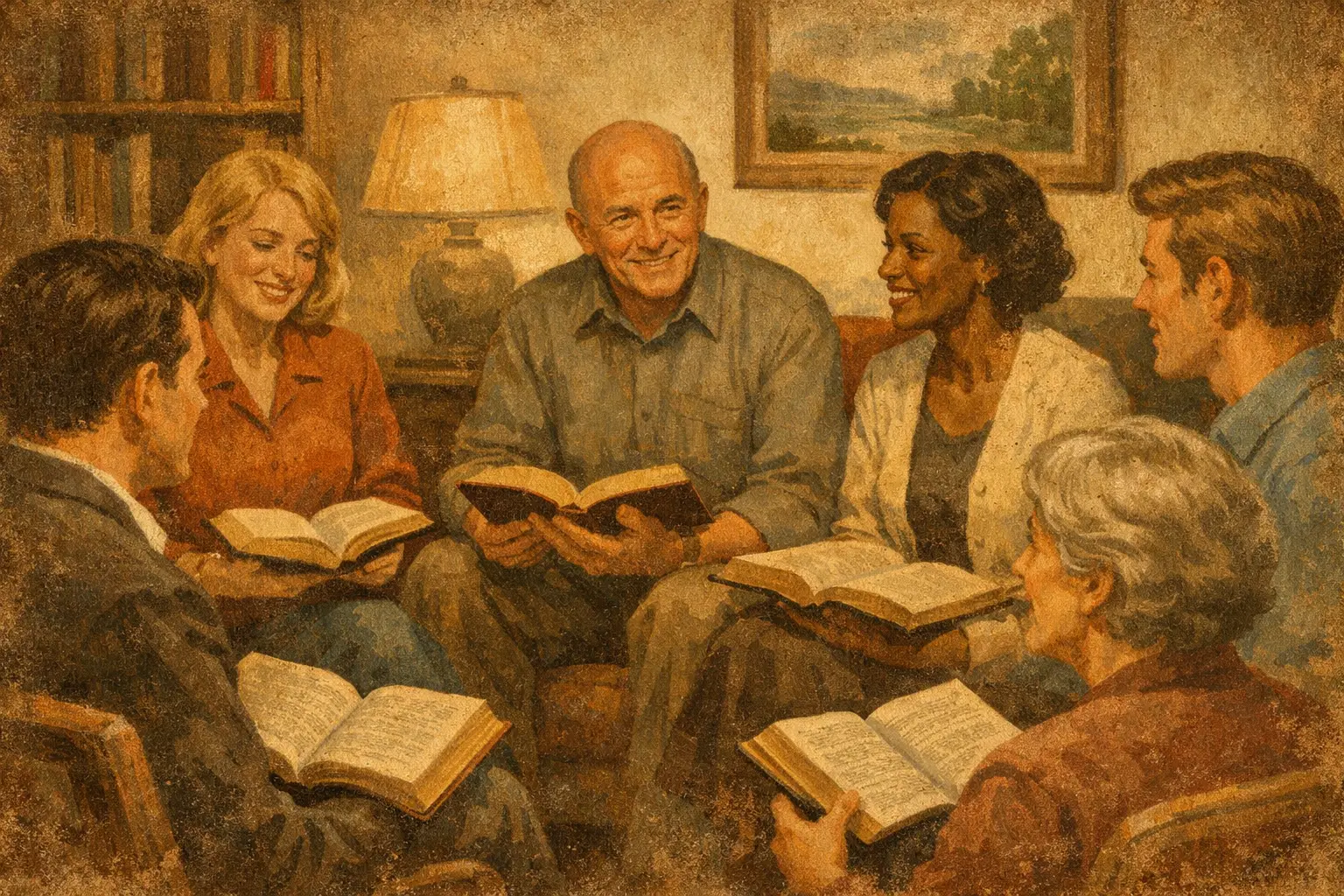
Some people don’t need more content. They need a few familiar faces, an open Bible, and a place to talk honestly. If you’re hoping to join a local scripture circle, that’s often what you’re really looking for – not a polished program, but a steady space for faith, questions, and connection.
For a lot of adults, that kind of community is harder to find than it should be. You may have moved suburbs, drifted out of a church small group, or never quite found one that felt natural. You may be strong in faith, or simply curious and willing to show up. Either way, you’re welcome here. A scripture circle doesn’t need to be formal to be meaningful.
What does it mean to join a local scripture circle?
At its simplest, a local scripture circle is a small group of people who meet regularly to read Scripture and talk about life with honesty and respect. It might happen in a lounge room, a café, a park, or online. The setting matters less than the spirit of the group.
The best circles tend to be small enough for everyone to speak and relaxed enough that no one feels they need the right words. That’s especially important if you’ve felt unsure about traditional church structures or if group settings have felt socially awkward in the past. A healthy circle creates room for both confidence and curiosity.
There’s also a difference between information and fellowship. Plenty of people can listen to sermons, podcasts, or Bible teaching on their own. What many are missing is a consistent place to ask, reflect, disagree gently, and pray with people who begin to know their name and story. That’s where a local scripture circle can matter deeply.
Who a local scripture circle is for
You do not need to be a Bible expert to join. You do not need to have the right church background, the right vocabulary, or a perfectly settled faith. In many cases, the people looking for this kind of group include long-time Christians who feel isolated, new residents trying to meet others nearby, shift workers needing something flexible, and people who are exploring Jesus for the first time.
That mix can actually be a strength. Mature believers often bring steadiness and lived wisdom. Newer or faith-curious participants often bring fresh questions that help everyone slow down and pay attention. The trade-off is that group culture matters. If a circle is too academic, newer people may feel lost. If it is too vague, those wanting spiritual growth may feel undernourished. The healthiest groups tend to balance clarity with warmth.
How to find the right fit
If you want to join a local scripture circle, start with realism rather than pressure. Not every group will suit every person, and that’s normal. A good fit usually comes down to three things: proximity, rhythm, and tone.
Proximity matters because even the most meaningful group can fade if travel becomes a hassle. A circle 10 minutes away is often more sustainable than one across the city, especially after a long workday. Rhythm matters because irregular groups tend to lose momentum. A fortnightly or monthly gathering can work well, but only if people know when to expect it and commit with reasonable consistency.
Tone may matter most of all. Ask yourself whether you’re looking for a highly structured study, a conversational group, a mixed-level discussion, or something gentle and beginner-friendly. None of these is automatically better. It depends on what helps you stay present and engaged.
Signs a group may be healthy
A welcoming scripture circle usually has simple habits that make people feel safe. People introduce themselves properly. Questions are allowed. No one dominates every conversation. Scripture stays central, but the atmosphere stays human. There’s room to laugh, pause, and admit when a passage is hard to understand.
It also helps when expectations are clear. You should know roughly how often the group meets, how long it runs, and whether prayer, reading aloud, or discussion prompts are part of the gathering. Light structure often works better than no structure at all because it lowers awkwardness without making the meeting feel stiff.
Signs to pause or look elsewhere
Some circles are sincere but not suitable for you. If the group feels performative, overly argumentative, or driven by one person’s agenda, it may not be the right place to settle. If newcomers are ignored, or honest questions are brushed aside, that can make connection difficult.
This doesn’t mean every uncomfortable moment is a red flag. Sometimes people are simply shy at first. But if the overall culture feels closed rather than hospitable, trust that instinct. Spiritual community should make room for truth and grace together.
What to expect when you join a local scripture circle
Most people worry about the first meeting more than anything else. That’s understandable. Walking into an unfamiliar room can feel vulnerable, especially when faith is personal.
In a healthy group, the first gathering should not feel like a test. You might begin with a simple introduction, read a short passage, and talk through a few prompts such as what stands out, what feels challenging, or how the text meets real life. Some circles close in prayer. Others keep that optional until trust grows.
You don’t need to have all the answers ready. In fact, one of the strengths of a good scripture circle is that people come as they are. Some will speak easily. Others will listen more at first. Both are fine. Belonging usually grows through repetition, not instant chemistry.
Why small, local circles often work better
Large events can be encouraging, but they rarely replace the depth of a smaller gathering. In a group of five to eight people, it’s easier to notice when someone’s had a hard week, easier to remember names, and easier to build trust over time.
Local circles also remove practical friction. If the meeting is nearby, simple to attend, and not over-programmed, people are more likely to keep coming. That consistency is where real community forms. It’s not built in one impressive night. It’s built through ordinary evenings where Scripture is opened and people show up again.
That’s part of why platforms like Bible Study Connect Group can be helpful. Rather than expecting people to already have the right network, they make it easier to be matched into small, local groups with a manageable format and a clear starting point.
If you feel nervous, start smaller than you think
You do not need to become the most outgoing person in the room to take a first step. Sometimes courage looks very ordinary. It looks like replying to a message, turning up once, or admitting you’re not sure what to expect.
If you’re a committed Christian, joining a local scripture circle may be the nudge you need back into regular fellowship. If you’re spiritually curious, it can be a respectful place to explore without pretending certainty you don’t yet have. The key is finding a group that values people over performance.
It can also help to set simple expectations for yourself. Aim to attend more than once before deciding whether the group is for you. First meetings are often a little tentative. By the second or third, people are more relaxed and conversation becomes more natural.
Building a circle that lasts
The groups that endure are not usually the flashiest. They are the ones that make participation easy enough to repeat. They meet at workable times. They keep discussion grounded. They welcome different personalities. They avoid turning every gathering into a heavy production.
There is a quiet strength in a circle that stays faithful to simple things – reading Scripture, listening well, praying sincerely, and checking in on one another between meetings. That kind of community can support people through loneliness, transition, doubt, and growth in ways that are deeply practical.
If you’ve been waiting for the perfect moment, you may not get one. Real community often begins a bit more plainly than that. You find a nearby group, you show up with honesty, and over time strangers become familiar. Sometimes that is where God meets people most gently – not in spectacle, but in a room where curiosity is enough and no one has to carry faith alone.